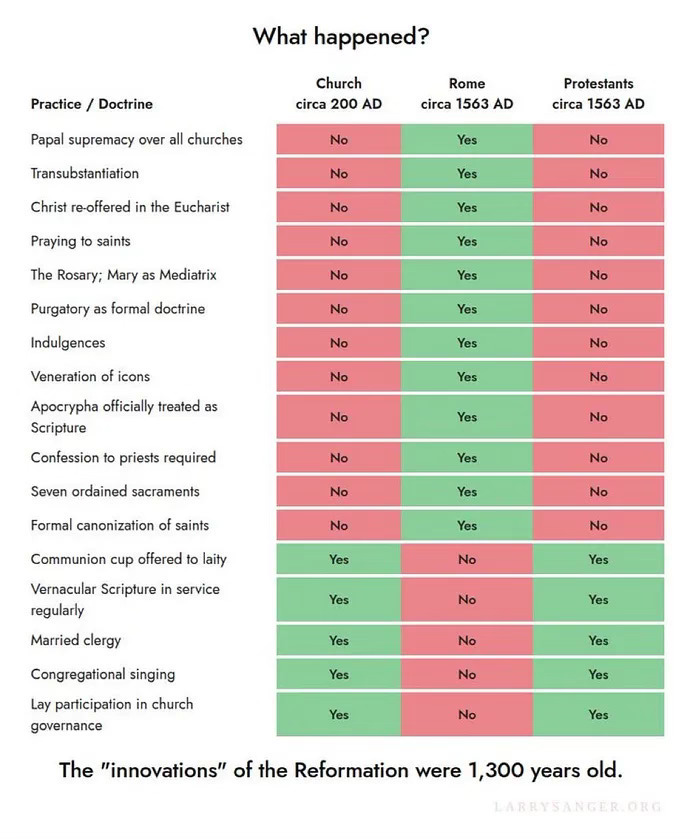
A chart has been circulating online that presents itself as a straightforward historical comparison of what the early Church believed to “Roman” innovations of the Middle Ages, and suggests that the Reformation restored authentic Christianity. But the chart tells lies by its existence, before it even begins making a single claim.

This lengthy article can be broken down into two parts. First I’ll address why the spreadsheet is a con job that immediately sets false parameters. In the second half I’ll address five of the claims found in it

(article continues below the chart)

For more articles like this, subscribe to The Forge

Part One: The Con Job

Before we get to what the chart says, we should talk about where it starts. The baseline for “the early church” is 200 AD. Not 33 AD. Not 100 AD. Not even 150 AD. Two hundred. That’s not a neutral choice. The first century of Christian history — the apostolic period, the letters of Paul, the writings of the men who knew the apostles personally is left off the chart. So is most of the second century. And that omission does enormous work in favor of the chart’s conclusion, because the witnesses closest to Christ and the apostles are precisely the ones who would most damage it.

Ignatius of Antioch, who, tradition holds likely knew the Apostle John, wrote around 107 AD. He described the Eucharist as the flesh of Christ in terms so direct that no Protestant commentary has ever fully explained them away.

Clement of Rome, writing in the late first century, intervened in the affairs of the church in Corinth with an authority that looks like something more than just a friendly suggestion from one congregation to another. These voices don’t get. representation anywhere on the chart. They predate the 200 AD cutoff, so they simply don’t exist within the chart’s frame of reference.

This is the chart’s central illusion. By starting at 200 AD, it cuts off the era where the roots of these doctrines are most visible, and then it marks them absent. It’s a false parameter. It’s cheating. It’s making you look up at the sky when the action is happening on the ground. It’s a magician working an illusion, or a con man plying his craft. The blank slate isn’t historical, it’s manufactured.

There’s a second problem with the chart’s logic. It treats the absence of a formally defined doctrine as evidence that the doctrine didn’t exist at all. And unless a person referencing this chart has some knowledge of church history and an understanding of how the church works, the tactic would likely not even be flagged.

Doctrine lives in the life of the Church long before it gets formally defined (preached, prayed, celebrated in the liturgy, handed down from one generation to the next). When a council eventually defines it, the council isn't inventing it, it’s exercising the Church's authority to take what has always been believed and make it official, locking it down in precise, binding language.

Keep in mind also that the early Church existed on the teaching of the Apostles, handed down from Sacred Tradition. Some reading this may be wondering why there weren’t automatically official declarations of these beliefs if the church already held them. The answer to that is that the church was still new, and church mechanisms that seem obvious to us today either did not exist yet in the early church or they hadn’t been fully developed yet in the early church. A mechanism for taking something from sacred tradition and making it a “official doctrine” was developed organically. It didn’t already exist because it wasn’t necessary in the early history of the church.

The trigger for a council and official declaration of a teaching/doctrine is usually controversy in the church. The controversy is the occasion, not the source. The doctrine as a belief and practice is always older than the official definition at a council. So t he fact that a council hadn't formally defined transubstantiation by 200 AD doesn't mean Christians in 200 AD didn't believe the Eucharist was the body and blood of Christ, or that the Church wasn't teaching and preaching it. It means nobody had yet forced the official definition.

With that in mind, let's look at the five most egregious claims in the chart.

Part Two: The Claims

These are the most off-the-wall claims in the chart, and they warrant the most attention.

Transubstantiation

The chart has transubstantiation as a “No” for the early church, probably on the grounds that the term itself wasn’t in use.

It’s true you’re not going to find the word “transubstantiation” in early church writings, but that’s not because the church didn’t believe it.

Get the rest by becoming a Member.

Become a Member to read the rest and access the full paid archive.

Join now Already have an account? Sign in